
West Hartford vs. Glastonbury vs. Farmington: What the School Rankings Really Say (and What They Don't)
 If you're relocating to the Hartford area because of the schools, you've probably already heard these three towns over and over: West Hartford, Glastonbury, and Farmington. And if you've done even a little bit of googling, you've probably noticed the rankings don't agree with each other.
Niche.com puts Glastonbury at #1 in the Hartford area and Farmington at #2. But when you look at Connecticut's own school accountability data, Farmington actually comes out ahead of Glastonbury. And West Hartford — which sits at #6 on Niche — is consistently one of the most requested towns I hear from relocating buyers.
So which ranking should you actually believe? Let's put all three districts side by side using real Connecticut education data, and then look at what it's actually like to buy a house and live in each town — because once you see the school numbers and the real estate picture together, this comparison gets a lot more interesting.
The Rankings Don't Even Agree With Each Other
Statewide, Niche ranks Glastonbury #7, Farmington #9, and West Hartford #20. Locally, that becomes Glastonbury #1, Farmington #2, and West Hartford #6.
But I'm a realtor, not a rankings company, so instead of telling you which district is "better," I want to show you the same data Connecticut itself publishes through its education data portal, EdSight. Rather than a single 1-to-100 ranking, Connecticut's Next Generation Accountability system scores districts across multiple indicators: academic achievement, student growth, graduation, college and career readiness, chronic absenteeism, and more.
Connecticut's statewide accountability index (2024–2025): 71.8
- West Hartford: 79.3
- Glastonbury: 82.3
- Farmington: 85.3
Notice what happens here — the order flips. Niche has Glastonbury ahead of Farmington. Connecticut's own accountability index has Farmington ahead of Glastonbury, with West Hartford behind both (though still well above the state average).
This is exactly why "what's the best school district" is the wrong first question. The answer depends entirely on which methodology you're looking at — which means rankings should be where your research starts, not where it ends.
Academic Performance: Closer Than the Rankings Suggest
Looking at the latest Connecticut performance index data:
- Farmington: ELA 76.3, Math 76.9 (statewide average: ELA 64.7, Math 61.1)
- Glastonbury: ELA 76.8, Math 76.1, Science 72.6 (statewide average for Science: 62.6)
Both districts are performing well above the state average — and much closer to each other than the rankings would suggest. This isn't one district running away from the other academically; it's two strong districts on these particular measures.
Achievement Tells You Where Students Are. Growth Tells You How Fast They're Getting There.
This is the part I think gets skipped over the most. Achievement scores show where students are performing right now. Growth scores show how much progress students are actually making year over year.
For Glastonbury, the latest data shows 65.8% ELA growth versus 60.6% statewide, and 71% math growth versus 62.3% statewide. If I were personally researching a district for my own kids, growth is a number I'd want to see — because a district can look strong on paper purely from achievement while growth tells a very different story.
High School and College Readiness
If you're buying with young kids, high school might feel far away — but it's worth looking at now. Glastonbury's latest data shows:
- 97.5% of students on track for graduation
- 96.8% four-year graduation rate
- 84.2% postsecondary entrance rate
- 85% participation in college and career readiness coursework, with 70.6% meeting the benchmark
For comparison, Connecticut's statewide four-year graduation rate is 88.9%, and statewide postsecondary entrance is 67%. These are the kinds of numbers worth digging into for any of the three towns — not just "ranked #1," but what's actually happening academically, with growth, and once students reach high school.
Size Matters More Than People Realize
Something that doesn't get nearly enough attention: these three districts are very different sizes.
- Farmington: roughly 4,000 students
- Glastonbury: roughly 5,700 students
- West Hartford: over 9,000 students
West Hartford is more than double the size of Farmington. That doesn't automatically make it better or worse — it just means a genuinely different environment. A larger district can offer a wider range of classes, programs, sports, and activities. A smaller district often provides a tighter-knit experience. Once you've narrowed down towns, look past the district-level ranking to the actual school your child would attend — the elementary, middle, and high school specifically — and the sports, music, clubs, and advanced courses that matter to your family.
Now Let's Talk Real Estate — Because This Is Where the Towns Really Diverge
Say you'd be comfortable with the schools in any of these three towns. Great — now what? Because living in West Hartford, Glastonbury, and Farmington are genuinely different experiences, and your budget buys you very different things in each.
West Hartford gives you the most walkable, active suburban lifestyle of the three, especially around West Hartford Center and Blue Back Square — restaurants, coffee shops, and a lot happening within walking distance depending on where you live. The housing has real character: colonials, two-families, capes, older homes on tree-lined streets in established neighborhoods. The trade-off is that, depending on price point and neighborhood, you may be buying an older home on a smaller lot with less square footage than the same budget would get elsewhere. Some buyers don't care — they want West Hartford, they want to be close to the Center, and they're happy to take the smaller house for the lifestyle.
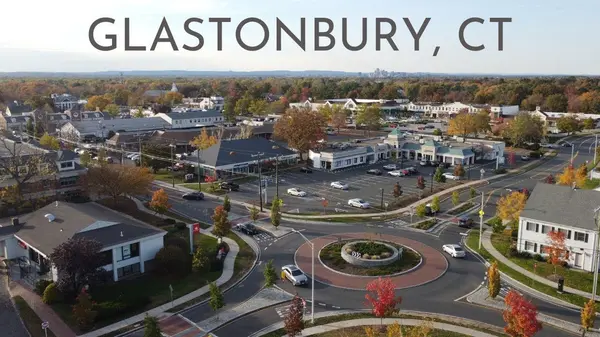
Glastonbury feels different the moment you cross the river. It's more spread out, with established neighborhoods, newer construction, luxury properties, larger lots, and a lot more privacy available. Parts of town feel suburban; keep driving and you'll find orchards, open land, and a much more rural feel. You still have restaurants, shopping, and easy access to Hartford, but you're not recreating the West Hartford Center experience. Some buyers want exactly that trade — a backyard and some space from the neighbors — over walkability.
Farmington offers yet another mix: historic areas, established neighborhoods, condos, newer homes, and luxury properties, plus Unionville, which has its own distinct feel. Location is a real advantage here too — close to the UConn Health area, with easy access toward West Hartford and the Farmington Valley. Depending on where you work, Farmington can make a lot of sense geographically.
So Which One Wins?
None of them, and that's the point. Niche says Glastonbury, then Farmington, then West Hartford. Connecticut's accountability index says Farmington, then Glastonbury, then West Hartford. Even the first two sources don't agree with each other — which tells you there's no magic ranking that decides where your family should live.
If you're weighing West Hartford, Glastonbury, and Farmington, don't get stuck on whether a town is #1, #2, or #6 on someone's list. Use the rankings as a starting point, dig into Connecticut's EdSight data, look at the specific schools your child would actually attend, and figure out which programs matter most to your family. Once you've done that, that's where I can help — showing you what your budget looks like in each town, how the housing stock differs, what the neighborhoods actually feel like, and what day-to-day life looks like in each one.
Thinking about a move to the Hartford area? Reach out and tell me your budget, your commute, and the lifestyle you're after, and we can start narrowing down which towns actually make sense for you to explore.
Learn more about this by watching my latest Youtube Video https://youtu.be/PsTwrxLlv40?si=OIEHpeg_TR7LzXQt
Categories
Recent Posts







Real Estate Professional License ID: RES.0804073
+1(860) 770-0029 | agnes.mroczka@raveis.com