
7 Red Flags Buyers Miss When They Fall in Love With a House
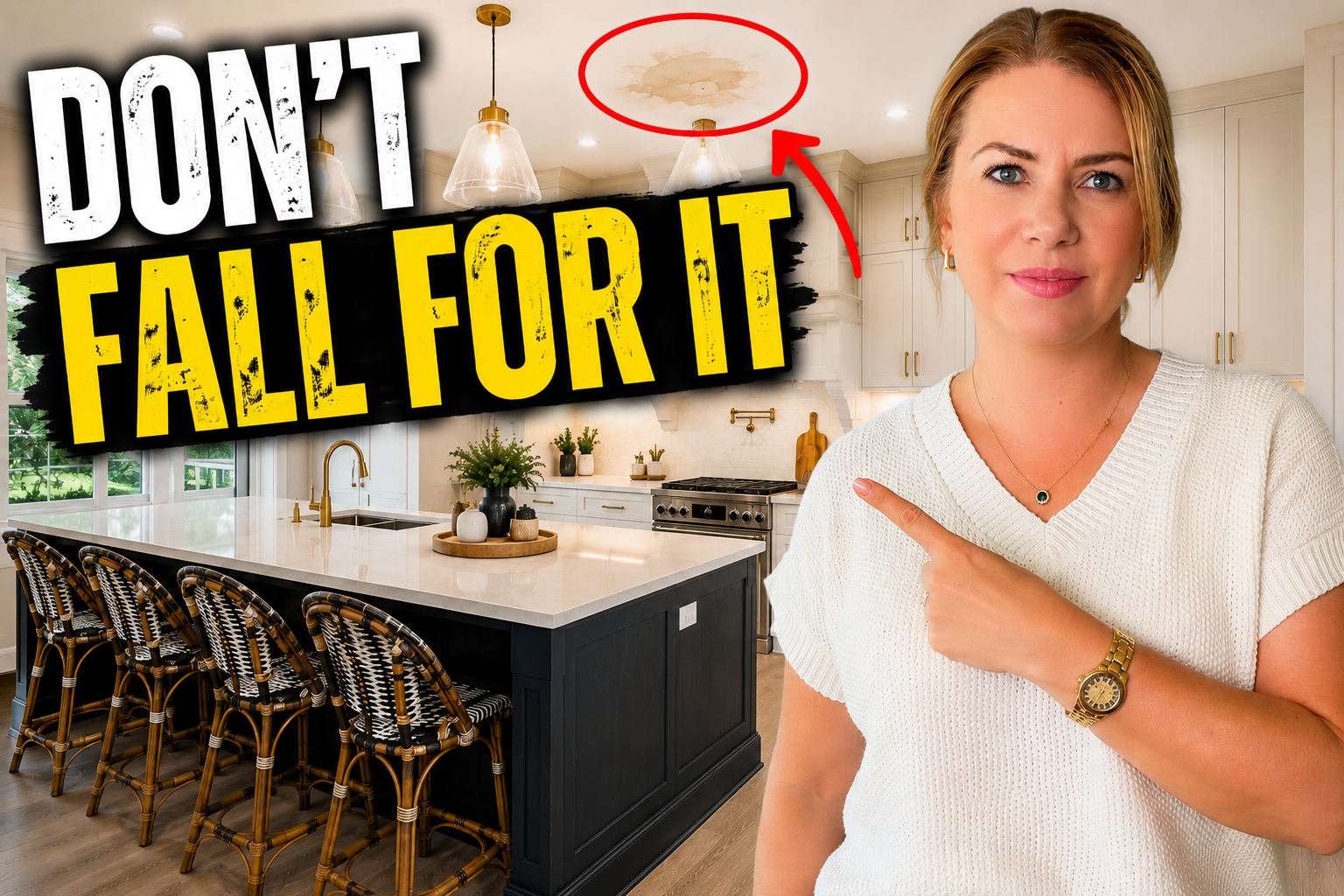
Have you ever walked into a house and within thirty seconds thought, this is it?
Beautiful kitchen. Gorgeous floors. Paint colors you'd have picked yourself. Staging that photographs like a magazine. Maybe that huge primary bathroom you've been dreaming about. And suddenly you're mentally moving in — figuring out where the Christmas tree goes, imagining your furniture in the living room, picturing your morning coffee on that deck.
That's exactly the moment I want my buyers to slow down.
Because some of the worst real estate purchases I've seen were absolutely beautiful houses. A beautiful house and a good buy are not necessarily the same thing.
I've been selling real estate in Connecticut for almost ten years, and one of the biggest parts of my job when I represent a buyer is looking beyond what the seller wants us to notice. Paint can be changed. Countertops can be changed. Light fixtures can be changed. But some things about a property are either incredibly expensive to fix or impossible to change at all.
Here are the red flags buyers most commonly overlook — and what I want my own clients paying attention to before they write an offer.
Red flag #1: You love the house, but you're ignoring the location
This is number one for a reason. You can renovate almost anything about a house. You cannot renovate its location.
Buyers know this intellectually. Then they walk into the right house and start making exceptions:
- "Yeah, the road is a little busy, but look at this kitchen."
- "Yeah, we're close to the highway, but the primary suite is amazing."
- "Yeah, there's a commercial building behind us, but look at this backyard."
Stop. Walk outside. Take the house away for a second and ask: would you buy this location?
Because when you eventually sell, the next buyer is going to have the exact same conversation you're having right now. If the busy road concerns you, it will probably concern them. If you notice the power lines, they will too. If you're wondering what's behind the property, so will they.
None of that automatically makes the house a bad purchase — price matters, and every property has trade-offs. But you need to understand what you're buying. I think about resale even when clients tell me, "Agnes, we're never moving again." I've heard that once or twice before. Life happens: jobs change, families change, relationships change, people relocate.
Buy the house you love. Just don't completely ignore the next buyer.
Red flag #2: The renovation looks amazing from six feet away
This one gets me all the time, especially with flips.
I'm not against flipped homes. I've seen fantastic ones where somebody truly cared about the property and did beautiful work. But I've also walked into homes that photograph perfectly until you start looking closer — cabinet doors that aren't aligned, gaps in the flooring, sloppy trim work, doors that don't close correctly, uneven tile.
And that's when I start thinking: if this is the quality of the work I can see, what does the work I can't see look like?
That's the real question. A beautiful backsplash doesn't tell me whether the electrical was done correctly. New flooring doesn't tell me what happened underneath it. Fresh drywall doesn't tell me what's behind the wall.
This is where permits, disclosures, and inspections become critical. If a listing says "completely renovated," ask:
- What exactly was renovated?
- Who did the work?
- Were permits required, and were they pulled?
- What happened to the plumbing? The electrical?
- Was anything structural changed?
Don't let the word renovated automatically translate to better in your head. Quality matters.
Red flag #3: Everything is new except the expensive stuff
Another classic. You walk in and it's new kitchen, new bathrooms, new flooring, fresh paint, new lighting — and buyers think, "We won't have to do anything."
Then we go downstairs and there's a forty-year-old furnace, aging electrical, and a water heater on its last legs. I ask how old the roof is and nobody knows.
Those things aren't as exciting as quartz countertops, but they're expensive. A beautiful $15,000 bathroom won't make you feel any better when you're replacing major systems a few months after closing.
So when you're touring a home, don't just ask what's new. Ask what's not new: roof, heating, cooling, water heater, windows, electrical, plumbing, septic if applicable, well equipment if applicable. Those boring questions can save you a lot of money.
Red flag #4: The basement is trying to tell you something
I spend a lot of time in basements — probably more than I'd like to admit. While everyone else is upstairs admiring the kitchen, I want to see what's happening downstairs.
Start with your nose. Does it smell damp, musty, or overly perfumed? Sometimes you walk into a basement and there are five air fresheners plugged in. Maybe the seller just likes air fresheners. Or maybe we're covering something up.
From there, I'm looking at the foundation walls, water staining, and efflorescence — that white powdery residue you sometimes see on concrete. I check around the windows, along the floor, and at the dehumidifiers and sump pumps.
Here's an important one: look at what's stored down there. If everything is sitting on pallets or shelves and nothing touches the floor, I want to know why.
Again, none of this automatically means don't buy the house. Plenty of Connecticut basements have moisture management systems, and a sump pump isn't inherently a red flag. What matters is understanding why it's there and whether the issue is being properly managed. That's the difference between noticing something and panicking about it.
Red flag #5: The lot looks huge — but is it usable?
A listing says two acres and buyers immediately picture a massive backyard. Then we arrive and the house sits on maybe a quarter acre of usable land, with the rest dropping straight down a hill, or it's wetlands, or heavily wooded, or there's an easement, or the lot shape is unusual.
This matters especially in Connecticut, where we deal with wells, septic systems, wetlands, ledge, slopes, and all kinds of interesting topography.
Don't just look at acreage — look at usable acreage. Where are the property lines? Where's the septic? Where's the well? Could you add a pool someday, or a shed, an addition, a garage, a fence?
Maybe you don't care today. But if part of your dream is "someday we'll put a pool back here," I want to know whether someday is actually possible.
Red flag #6: You're stretching your budget just to get the house
This one isn't physical, but it's a big one.
You've found the house. There are multiple offers. Suddenly it's just another $25,000 — and then another $20,000. Now you're waiving things you weren't planning to waive. Your mortgage payment is higher. Your taxes are higher. Maybe the home has a pool, a bigger yard, higher utility bills. And you've spent most of your available cash just getting through closing.
Owning a house costs money after you buy it. Things break. Things need maintenance. The house doesn't care that you drained your savings at the closing table.
I never want a buyer to get so emotionally attached that they stop making financial decisions and start making emotional ones. There's always another house. It may not feel that way in the moment, but there is.
Red flag #7: You're explaining away too many things
This is probably my favorite test.
One compromise is normal — every house has something. Two is probably fine too. But listen to yourself during the showing:
We can live with the road. We can fix the basement eventually. The bedrooms are small, but it's okay. The taxes are higher than we wanted, but we'll figure it out. The commute isn't ideal. There isn't really a backyard, but…
At some point I have to ask: do you actually love this house, or are you trying to convince yourself to love it? Those are very different things.
No house is perfect, and I don't want buyers chasing perfection — they'll never buy anything. But your compromises need to make sense, and you need to know which ones can be fixed and which ones you'll live with for as long as you own the property.
Bonus: Don't let competition make the house better than it is
This happens constantly in hot markets. You like the house. Then you hear there are already five offers — and suddenly you love it. Funny how that works.
Competition creates urgency, and urgency creates emotional attachment. At that point you're not buying the house anymore, you're trying to win it. Those are two completely different goals.
Winning a bidding war doesn't automatically mean you made a good purchase. The goal isn't to beat everyone else; it's to buy the right house on terms that still make sense for you. Sometimes my job is to help a client win. Sometimes my job is to say, "We're done here — let somebody else have this one." I'm perfectly comfortable doing that.
What I want you to remember
A beautiful house can absolutely be a great buy. Just don't let the beauty distract you from the fundamentals.
You can change the paint. You can replace the countertops. You can renovate the bathroom and rip out the flooring you hate. You cannot make the lot twice as big. You cannot shorten the commute. You cannot magically lower the property taxes. And you cannot undo an overpayment once you've closed.
So when you walk into a house and fall in love, enjoy it. Get excited — that's part of buying a home. Then bring the emotion down just enough to ask: does this house still make sense when I stop looking at how pretty it is?
That's where a good buyer's agent comes in. My job isn't to sell you every house we walk into. It's to help you understand what you're buying — the good, the bad, and the things you didn't know to look for.
If you're planning a move to Connecticut and need help figuring out where or what to buy, reach out anytime.
Agnes Mroczka, REALTOR® William Raveis Real Estate HomesWithAgnes.com | Instagram @agnes_realestate | YouTube @LivinginCT-Agnes
Categories
Recent Posts








Real Estate Professional License ID: RES.0804073
+1(860) 770-0029 | agnes.mroczka@raveis.com